#0 TEST
7 videos7 files8 tests
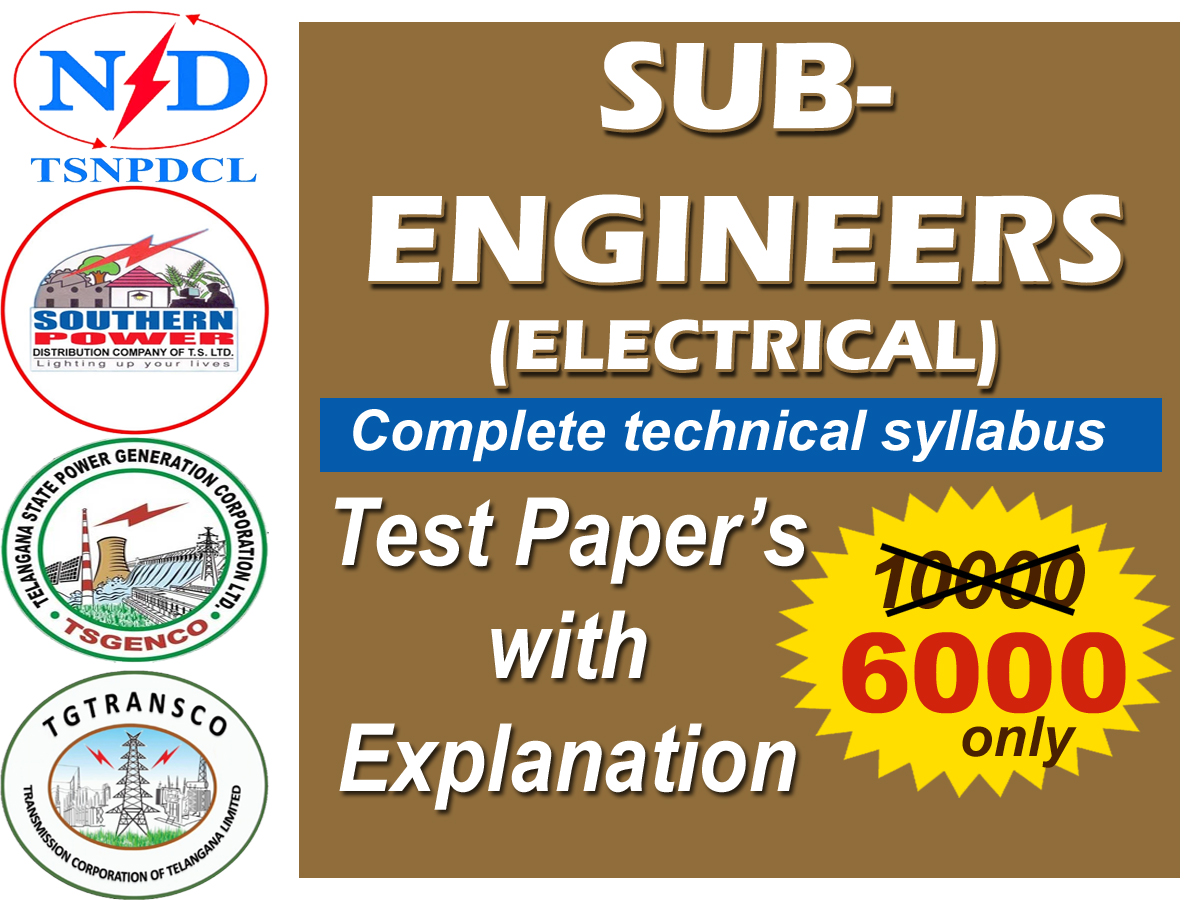
Section-A: 80 Marks.
Diploma in Electrical Engineering.
I. ELECTRICAL MACHINES:
TRANSFORMERS: Emf equation of single phase transformer, operation of transformer on load, equivalent circuit, vector diagram, open-circuit and short-circuit tests, voltage regulation, losses and efficiency, all-day efficiency, parallel operation of single-phase transformers with equal voltage ratios. Voltage and current relations for three-phase transformer connections. Principle of operation of auto-transformer. Cooling of power transformer, Operation of Buchhloz’s relay.
D.C. GENERATORS AND MOTORS: Expression for emf equation of D.C.Generator, armature windings, armature reaction, types of generators, characteristics. Torque equation of D.C.Motor, characteristics, speed control, starters, losses and efficiency. Testing of D.C. Machines.
THREE-PHASE INDUCTION MOTORS: Constructional aspects of cage and wound rotor types of induction motors, expression for torque, torque-slip characteristics, full load torque, starting torque and maximum torque, effects of variation of rotor resistance; losses and efficiency; different starting methods; speed control methods.
SINGLE-PHASE INDUCTION MOTORS AND COMMUTATOR MOTORS: Constructional features and operation of single-phase induction motors: split phase, capacitor and shaded pole types. Principle of operation of A.C. series motor, universal motor, Schrage motor.
II. SWITCHGEAR AND PROTECTION:
FAULTS AND SWITCHING APPARATUS: Short-circuit calculations; fuses and isolators; circuit breakers: theory of arc interruption and different types of oil circuit breakers; lightning arrestersand their selection and location.
PROTECTIVE RELAYING: Basic requirements of protective relaying, primary and back-upprotection; classification of electromagnetic relays and their principles of operation; time current characteristic curves; induction type over-current relay, distance relays; Merz price protection, differential protection of transformers, bus bar protection.
III. TRANSMISSION :
LINE CONDUCTORS, LINE SUPPORTS AND SAG CALCULATIONS: Different types of lineconductors, conductor sizes commonly used for different voltage levels, Types of line supports, factors influencing the selection, cross-arms; spans, conductor spacings and ground clearances. Sag calculations and stringing charts.
TRANSMISSION LINE PARAMETERS: Determination of inductance and capacitance of roundand parallel conductors in single phase and three-phase symmetrically spaced lines.
PERFORMANCE OF LINES: Choice of voltage; short, medium and long lines; calculation of sending-end voltage, regulation and efficiency for short lines; nominal and nominal-T methods; Ferranti effect; corona: critical voltages and factors affecting corona.
INSULATORS AND SUBSTATIONS: Different types of insulators: Pin type, strain type, suspension type and relative merits; voltage distribution across string of suspension insulators, string efficiency and methods of improving arcing horns. Equipment used in substations, bus-bar arrangements.
CABLE AND DISTRIBUTION SYSTEMS : Comparison between overhead lines and under ground cable. Types of cables, insulation resistance; localization of cable faults. Primary andsecondary distribution; Feeders and service mains; radial and ring systems of distribution.
IV. MEASURING INSTRUMENTS AND ELECTRIC CIRCUITS:
MEASURING INSTRUMENTS: Indicating instruments: deflecting, controlling and damping torques, pointers and scales; ammeters and voltmeters: moving coil, moving iron, dynamometer, induction types; instrument transformers: C.T and P.T., Wattmeters andmeasurement of power in three phase systems by two-wattmeter method; measurement of energy: Energy meters; M.D. indicators; trivector meter.
ELECTRIC CIRCUITS: Fundamentals of alternating current quantities, sinusoidal waveform; average and effective values; J-notation for A.C quantities; polar form; single phase series andparallel circuits; impedance triangle, phase, power factor. Active and reactive components of power; series and parallel resonance. Three-phase star and delta balanced systems.
V. UTILIZATION OF ELECTRICAL ENERGY:
ELECTRIC DRIVES: Factors governing selection of motors; matching of motors with given loads; electric braking; rating of motor; types of enclosures; motors for particular drive.
ILLUMINATION: Definitions of commonly used terms and units; types of lamps; requirements of good lighting; laws of illumination; terms like : depreciation factor, utilization factor, waste light factor, luminous efficiency, specific energy consumption, space height ratio.
ELECTRIC HEATING AND WELDING: Requirements of good heating materials, materialsgenerally employed, resistance heating; electric furnace; induction heating; dielectric heatingwelding generator and transformers.
Section-B:
20 Marks.
General Awareness and Numerical Ability :
i) Analytical & Numerical Ability
ii) General Awareness
iii) English
iv) Related to Telangana Culture & Movement
http://file:///C:/Users/worki/Downloads/SUB_ENG_NOTIFICATION_2018.pdfv) Computer Knowledge.
₹6,000